
How to achieve precise data synchronization in the telecom industry
A well-known problem with various customers: low address-matching rates due to discrepancies like street abbreviations, building details, complex house numbers, and minor errors – even when client data appeared to follow the expected format. The absence of a unified data exchange standard further hindered consistent results.
We last applied a proven approach that we can use with various clients to this problem in 2024 for a telecom case: with a customized technical solution that focuses on both precision and data protection. The result was a scalable, reusable system with minimal reliance on third-party tools.
Overcoming Inconsistent Address Formats
The customer’s goal was simple: improve the success rate of data matching with high accuracy and a low false positive rate. However, this was not a straightforward task. The data provided by clients came in a wide range of formats, and even the most carefully structured datasets still contained issues like abbreviations for street names, varying formats for house numbers, and typos. Address matching between different formats, especially when dealing with large datasets, required a sophisticated solution that could handle a wide range of cases.
Scalable Data Normalization & Fuzzy Matching
Our solution was designed to be scalable, deterministic, and reusable. The process involved two primary steps:
Data Normalization: The first step was to normalize the incoming data to ensure consistency. A CSV template was provided to the clients for entering large numbers of addresses. While the format of the data provided could be semi-unified, it still required additional normalization to eliminate discrepancies. For example, abbreviations in street names like “str.”, “str”, “straße” or “strasse” were standardized to “strasse.” We also accounted for variations in house numbers, zip codes, and the use of special characters. This step ensured that the address elements, such as street name, zip code, and house number (e.g. 12, 12A, 12A-D, 12/A), could be compared in a consistent format.
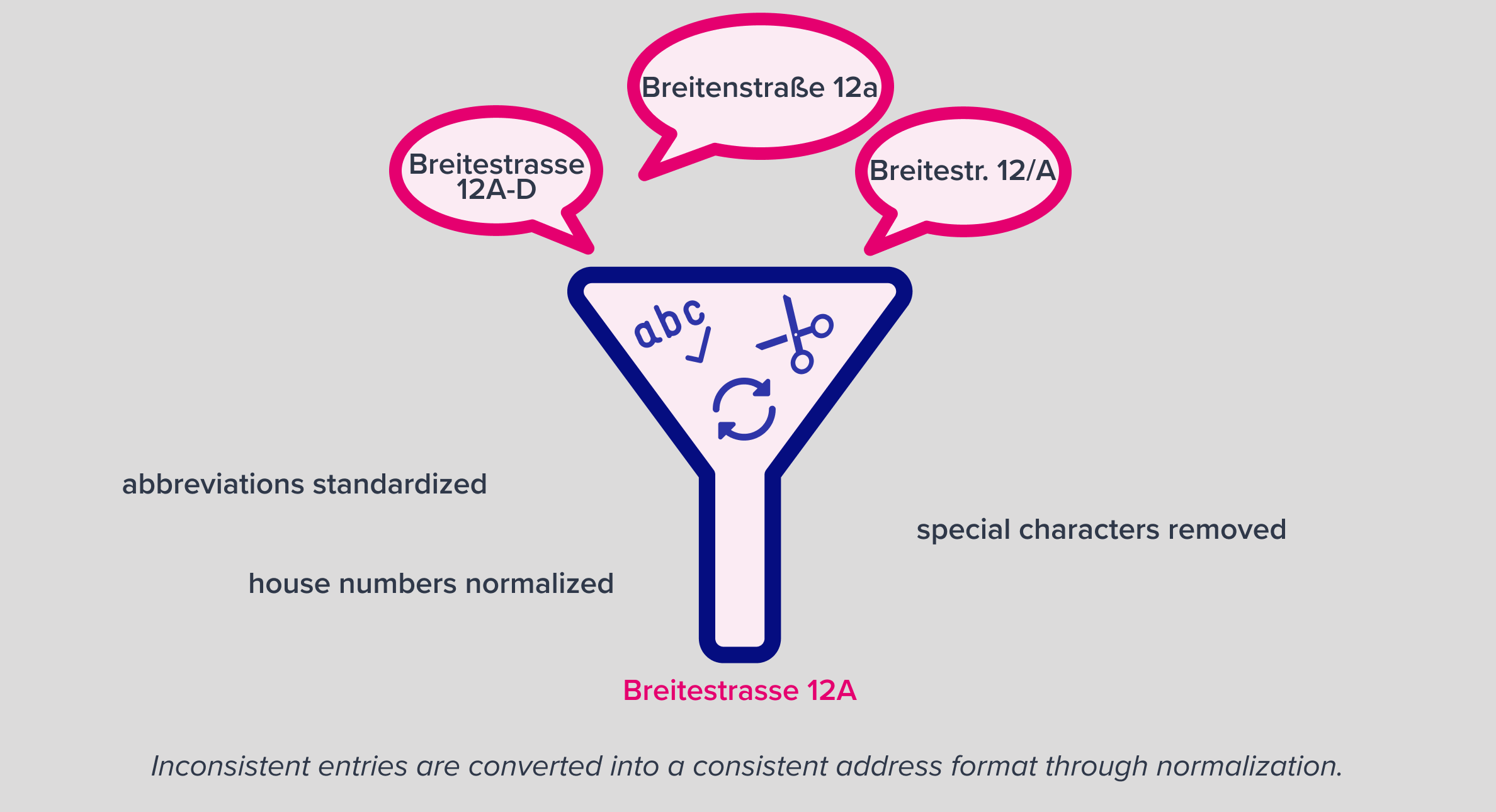
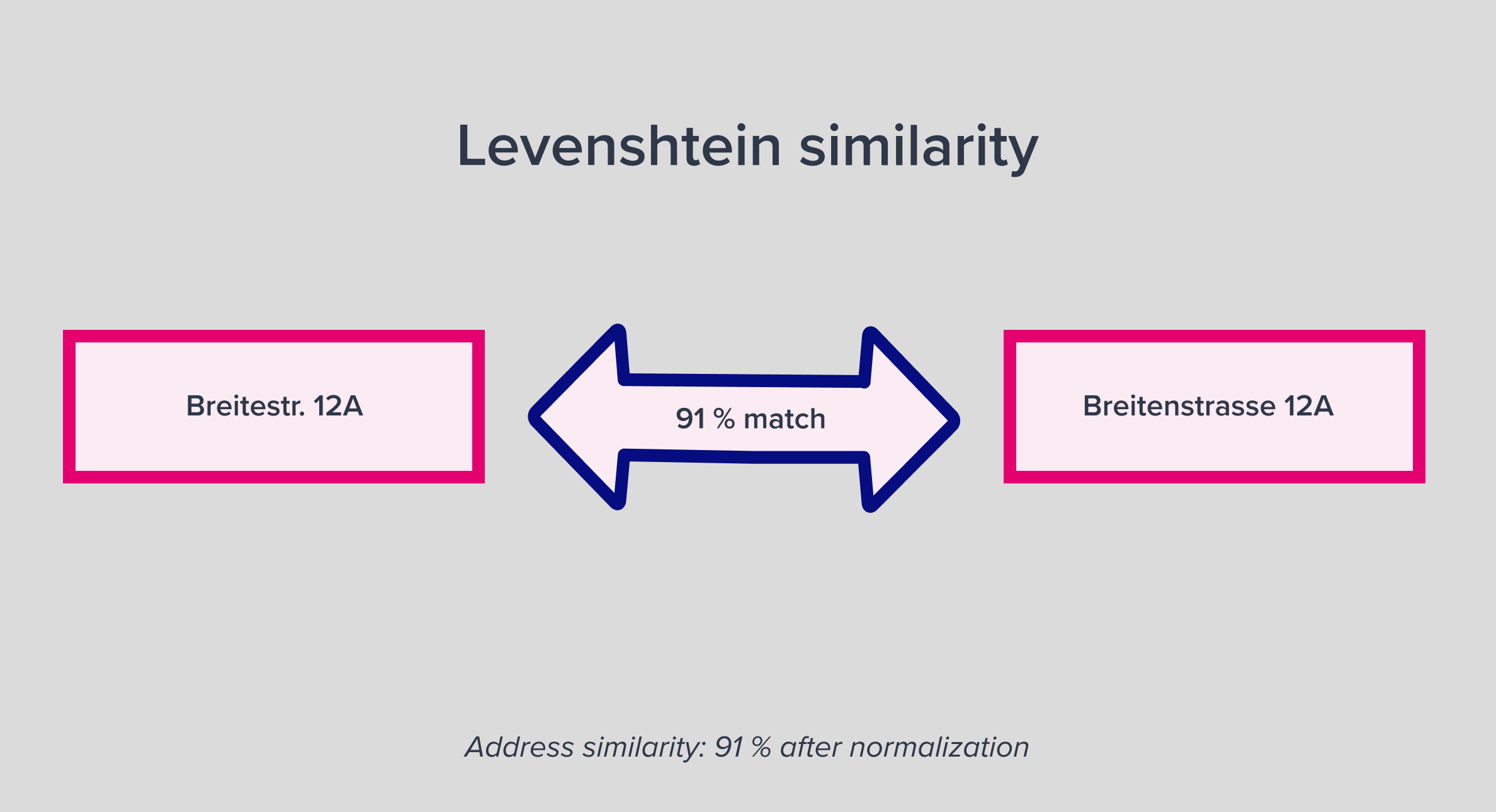
Fuzzy Matching: After normalization, we applied a fuzzy matching approach. The system compared multiple criteria, starting with the region, followed by the town, street name, and house number. We leveraged the Levenshtein distance algorithm, which calculates how much one string differs from another, allowing for matching even when minor differences existed. For example, the system could identify a match between street names like “Breitestr.” and “Breitenstr.”. The system also validated, normalized and cleaned house numbers for an exact match.
Once a match was made, addresses that didn’t meet the criteria were flagged for manual review. This feedback loop helped improve data quality and allowed the client to make necessary corrections on their end.
Higher Accuracy & Reduced Manual Effort: How Automation Really Helps With Matching
The implementation of this system led to a major improvement in data matching accuracy. The customer saw a significant increase in automated matching of client data to their internal database. This not only reduced the manual work involved in validating addresses but also ensured that customer data was handled securely and without the need for third-party services.
The solution was implemented directly on the database level using PSQL functions, triggers, and regular expressions, ensuring high performance and minimizing external dependencies. By fully automating the process, the customer was able to handle large datasets efficiently while maintaining a high level of data privacy.
Address Matching on a New Level: Fast, Secure, Scalable
Address matching may seem like a simple task, but when dealing with millions of client records in varying formats, it can quickly become a complex challenge. With our solution, the client was able to enhance its data matching processes significantly, ensuring accuracy and reliability while maintaining control over its data.
In a world where data is more valuable than ever, having robust data management systems in place is essential. Our technical solution provided a much-needed improvement for the company, driving efficiency, reducing manual errors, and ensuring a seamless experience for both the company and its clients.
Your contact at UFirst

Jordán Jarolím
Start your digital future with us.
We look forward to it!